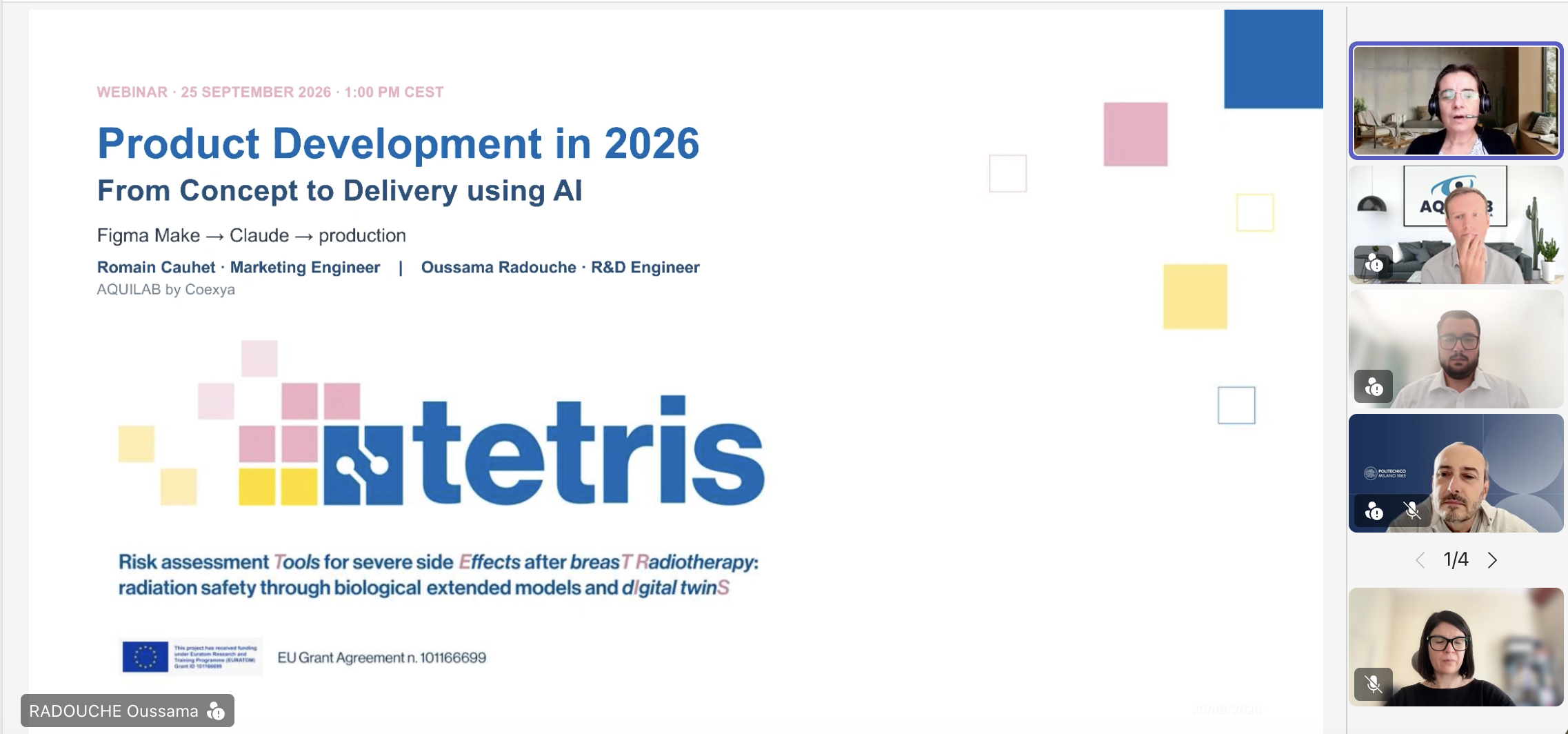
On 25 September 2026, TETRIS hosted the fifth online event of its Educational Webinar Series, continuing its programme of open educational events designed to share knowledge and expertise from across the consortium for a wider audience.
The webinar, entitled “Product Development in 2026: From Concept to Delivery using AI”, was delivered by Romain Cauhet, Marketing Engineer, and Oussama Radouche, R&D Engineer, from AQUILAB by Coexya.
The session offered a practical introduction to the methodology and programming behind modern software development, exploring how an initial concept can be transformed into a working product and how Artificial Intelligence is changing different stages of today’s development workflow.
From an idea to a working prototype
The first part of the webinar, led by Romain Cauhet, focused on design and user flow, introducing Figma Make and a seven-step methodology for moving from an initial brief to a prototype that can be tested with users. The process covered defining the brief, importing a design system, creating effective prompts, integrating existing resources, iterating on the prototype, validating the user flow and gathering feedback from users.
A central message of the session was that AI can make it possible to create and test working prototypes much earlier in the development process. This allows teams to validate ideas and user flows before investing in more complex development activities. However, the speakers stressed that AI does not eliminate the work involved in software development: it changes where that work takes place, placing greater importance on decision-making, verification and assessing whether generated outputs can be trusted.
From prototype to production
The second part, led by Oussama Radouche, moved from prototype to code and delivery, looking at how generated code can become the starting point for further development rather than simply being discarded after the prototyping phase.
The webinar highlighted the important distinction between a working prototype and a production-ready product. While a prototype can already reproduce the interface and user flow, moving towards a real product requires additional work on areas such as real data, authentication, user roles and permissions, automated testing, monitoring and reliability.
Participants were also introduced to a workflow combining tools such as Figma Make, GitHub and Claude, illustrating how AI can support different stages of development while keeping human review at the centre of the process. As highlighted during the webinar, testing, security, compliance and deployment remain just as important in an AI-supported workflow as in traditional software development.
AI as a tool, not a replacement for human expertise
One of the key messages emerging from the fifth TETRIS Educational Webinar was that AI can accelerate and reshape software development, but it does not replace product decisions, domain expertise, security and compliance requirements, or human accountability.
For research projects such as TETRIS, understanding these new approaches is particularly relevant as increasingly sophisticated scientific concepts and data need to be translated into practical, reliable and user-oriented digital tools.
The webinar provided participants with an accessible look behind the scenes of this process, from the first idea and prototype to code, testing and final delivery.
Missed the webinar? To watch the full 5th TETRIS Educational Webinar session on YouTube, click here.
To download the slides of the webinar, click here for the pdf.
For the 6th appointment of the TETRIS Educational Webinar Series, stay tuned, it’s coming during TETRIS 3rd General Assembly in Stockholm.