
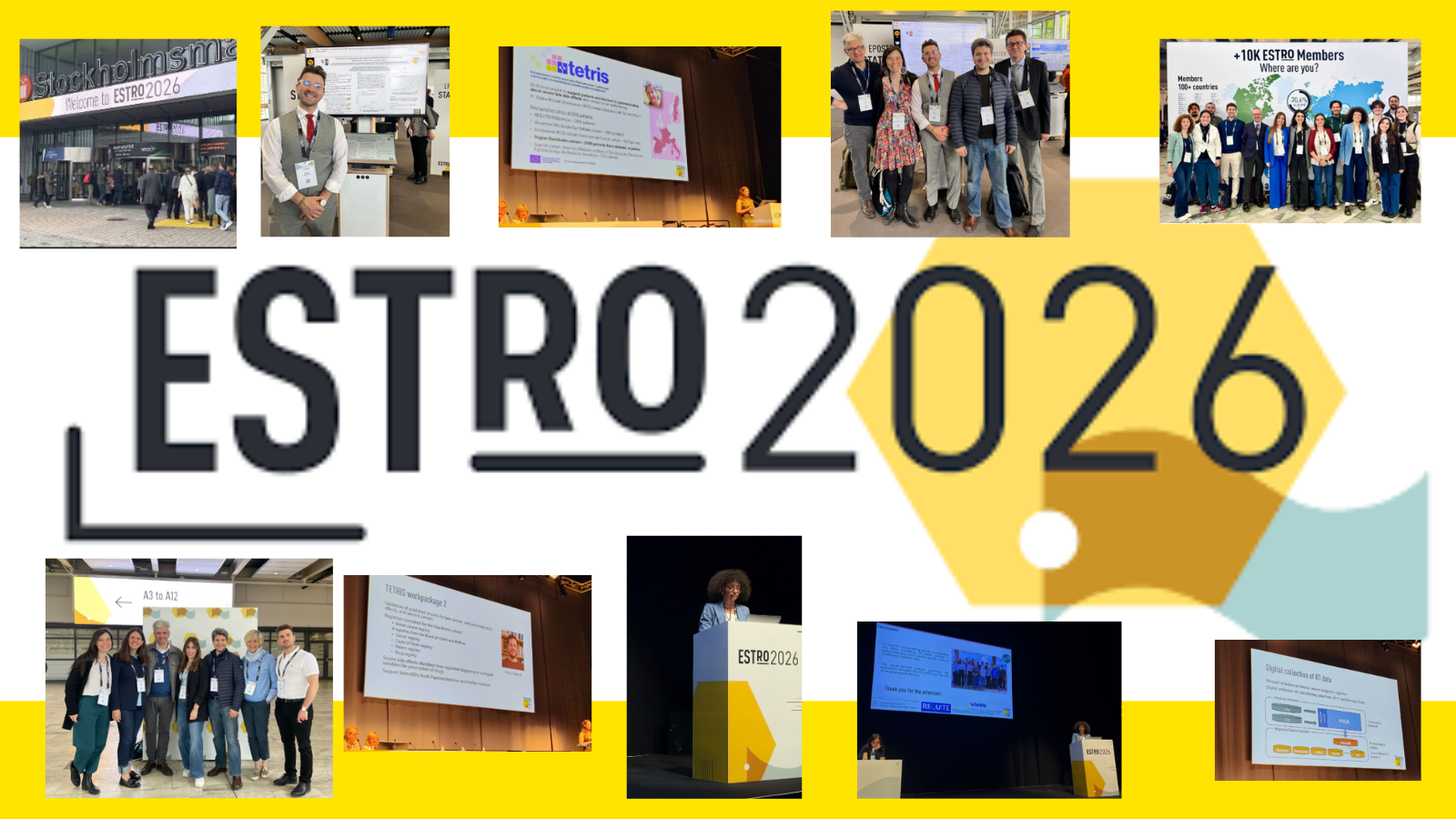
The TETRIS project was strongly represented at the 2026 Annual Congress of the European Society for Radiotherapy and Oncology (ESTRO), held in Stockholm, Sweden, from 15 to 19 May, where several researchers from the consortium presented ongoing work developed within different TETRIS Work Packages.
The conference provided an important opportunity to share scientific results, exchange ideas with the international radiotherapy community, and discuss innovative approaches to advancing personalised and safer radiotherapy.
Researchers from the Università Vita-Salute San Raffaele (UniSR) presented two studies conducted within the framework of TETRIS.
Alfonso Belardo and Marco Fois showcased the posters “Predictors of cardiotoxicities after hypo-fractionated whole breast radiotherapy: dependence on the type of cardiac event” and “CT-based Predictors of Radiation-Induced Pulmonary Toxicity in Breast Cancer Patients”. The studies contribute to the development of predictive models for radiation-induced side effects, a key objective of the project.
Please, find here Poster “Predictors of cardiotoxicities after hypo-fractionated whole breast radiotherapy: dependence on the type of cardiac event” and here Poster“CT-based Predictors of Radiation-Induced Pulmonary Toxicity in Breast Cancer Patients”.
TETRIS research was also presented by Benedetta Dionisi Ferrera, researcher at the CMON Lab of Fondazione IRCCS Istituto Nazionale dei Tumori di Milano. As part of her PhD research, she presented analyses aimed at defining a genetically adjusted radiation dose for normal tissues, with the goal of better understanding dose-effect relationships following breast cancer radiotherapy and assessing their association with the risk of developing late fibrosis through a causal inference framework. To go through Benedetta Dionisi Ferrera’s presentation on Normal tissue genetically-adjusted radiation dose (NT_GARD) for causal inference models of late toxicity after breast cancer radiotherapy, click here.
Another contribution came from Eva Onjukka of Karolinska University Hospital, who delivered the presentation “The Power of Local and Nationwide Radiotherapy Quality Registries.” During her talk, she highlighted the value of quality registries in supporting research and evaluating patient care, while also presenting the TETRIS project as an example of how registries can facilitate the collection of large-scale data on severe side effects through registered diagnoses and surrogate variables such as medication prescriptions. Please find here Eva Onjukka’s presentation “The Power of Local and Nationwide Radiotherapy Quality Registries.”
The participation of researchers from several TETRIS partner institutions reflects the multidisciplinary nature of the project and the wide range of activities being carried out across its Work Packages, from clinical modelling and imaging to genetics, registries, and personalised risk prediction.
ESTRO 2026 once again proved to be an invaluable platform for disseminating TETRIS research, strengthening collaborations, and contributing to the future of precision radiotherapy and improved patient care.
ESTRO 2027 will be held in Milan from 21 to 25 May!