Words matter. In radiotherapy, they can shape the entire treatment experience.
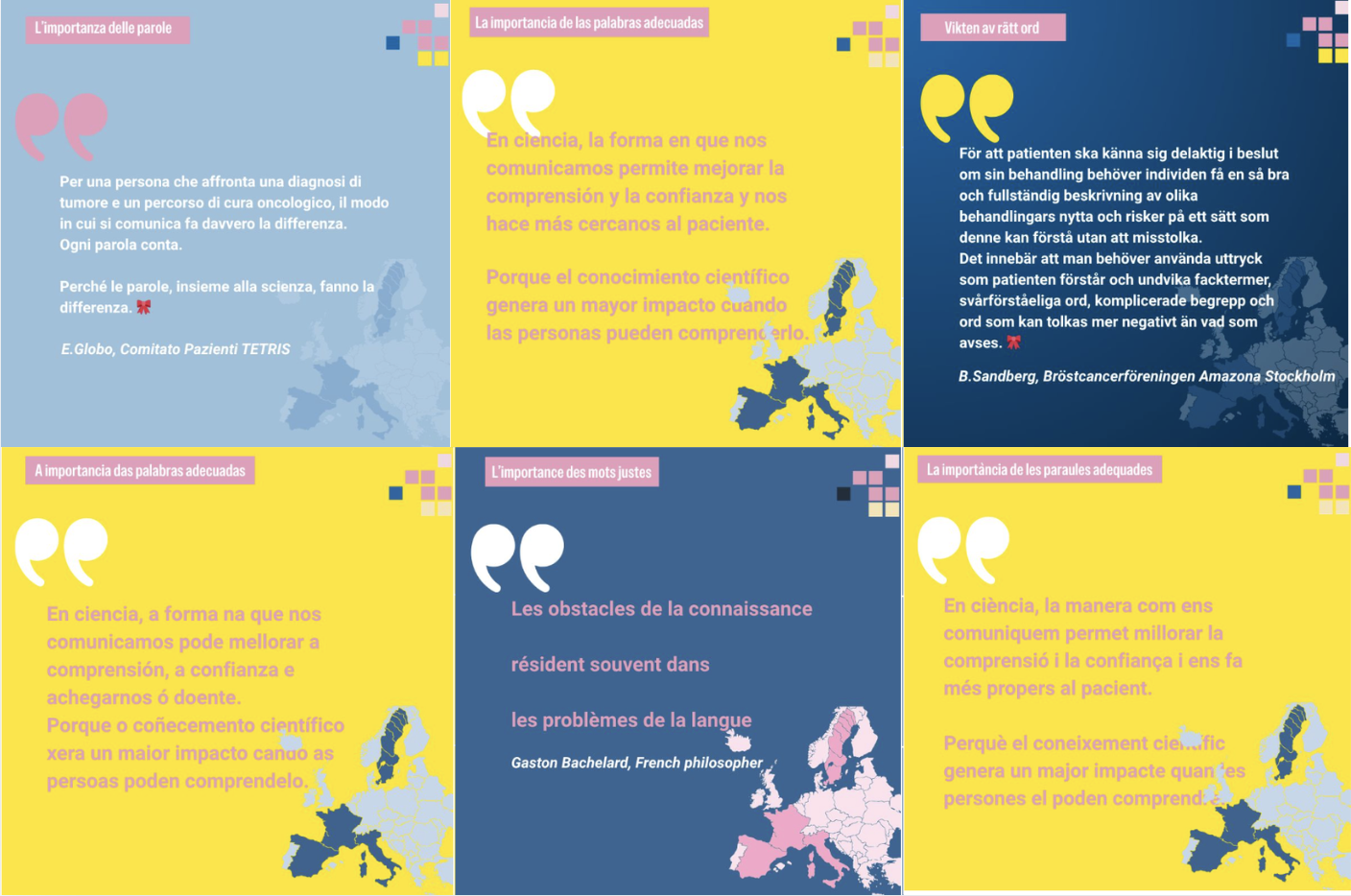
The TETRIS project has launched a multilingual communication campaign “The Importance of the Right Words“ to raise awareness about the impact of language in radiotherapy, both in clinical practice and in scientific communication, inspired from an article of ESTRO “Radiotherapy cures cancer – and words can help us cure mistrust.“
The initiative brings together the voices of patients, clinicians, and researchers across Europe, and has reached audiences in English, Italian, Swedish, French, Spanish, Catalan and Galician.
Why language matters in radiotherapy
In radiotherapy, the words professionals use every day carry weight far beyond their technical meaning.
Terms like “toxicity”, “organs at risk”, or “dose constraints” are precise and well-established within the scientific community. But when they reach patients, caregivers, policymakers, the media, or colleagues outside the specialty, they can create unnecessary alarm, confusion, or a distorted perception of what radiotherapy actually involves, an effective, organ-sparing, high-value treatment for cancer.
Improving the language we use does not weaken science. On the contrary, it can support informed consent, shared decision-making, and public trust in radiotherapy.
The campaign advocates for a simple but meaningful shift in terminology:
- “Side effects” or “Adverse events” instead of “Toxicity”
- “Dose guidance” instead of “Dose constraints”
- “Organs of interest” instead of “Organs at risk”
- “(Set-up) variations” instead of “(Set-up) errors”
Patient-centred language can make a real difference, not by replacing scientific precision, but by complementing it.
The patient perspective
The campaign opened with the voices of patients. Bröstcancerföreningen Amazona Stockholm and the Karolinska University Hospital shared the perspective of breast cancer patients and patient advocates in Sweden: for a patient to feel genuinely involved in decisions about their treatment, they need to receive a clear, complete, and accessible description of the benefits and potential effects of different therapeutic options, without the burden of misunderstanding technical language that may sound more frightening than it truly is. As Amazona’s contribution put it: “Words shape understanding, trust, and the patient experience.”
From Italy, the patient association Cuore di Donna and the Fondazione IRCCS Istituto Nazionale dei Tumori (INT) in Milan brought a deeply human perspective: knowing what may happen, being able to name and understand potential effects of a treatment, helps patients feel more prepared and less alone in facing uncertainty. This requires more than information, it requires a genuine commitment to making medical language more accessible, warmer, and more respectful of the person. As their contribution stated: “Because the quality of care also passes through this: the words we choose, every day.“
The scientific perspective
From the research community, the Vall d’Hebron Institute of Oncology (VHIO) and the Fundación Pública Galega de Medicina Xenómica (FPGMX) contributed to the campaign in Spanish, Catalan, and Galician, reinforcing the message from within the radiotherapy science ecosystem: better terminology is not a question of softening clinical reality, but of ensuring that science communicates clearly, accurately, and with sensitivity to how language is received across different communities and contexts.
AQUILAB and Neolys Diagnostics carried the campaign into French-speaking audiences, extending the reach of the message across European linguistic communities.
A collective European effort
The campaign is a concrete example of how TETRIS integrates patient engagement into its scientific mission. The TETRIS Patient Advisory Board, which includes Bröstcancerföreningen Amazona Stockholm and Cuore di Donna, plays an active role in ensuring that patients’ perspectives are not just acknowledged, but woven into the research process itself.
The campaign posts in all languages are available on the TETRIS LinkedIn page and on the TETRIS social media channels.
For further reading on the evidence behind patient-centred communication in radiotherapy, see the scientific publication linked in the campaign by ESTRO: Read more.