The TETRIS project has successfully launched its Educational Webinar Series with the first webinar dedicated to researchers and professionals and a broader interested audience.
The first webinar took place on Thursday, 22 January, from 13:00 to 14:00 CET, marking an important step in the project’s efforts to promote knowledge sharing and capacity building within and beyond the consortium. The session, titled “Dose-response modelling for normal tissues and model selection strategy”, focused on key methodological aspects relevant to radiation oncology and risk assessment.
The webinar was delivered by Eva Onjukka, Associate Professor, and Filippo Schiavo, Postdoctoral Researcher, from Karolinska University Hospital and was hosted and moderated by Tiziana Rancati, from the Fondazione IRCCS Istituto Nazionale dei Tumori di Milano, Principal Investigator of the project.
Key Topics
Eva Onjukka opened the webinarintroducing the fundamentals of predictive modelling in radiotherapy and their role within the TETRIS project.
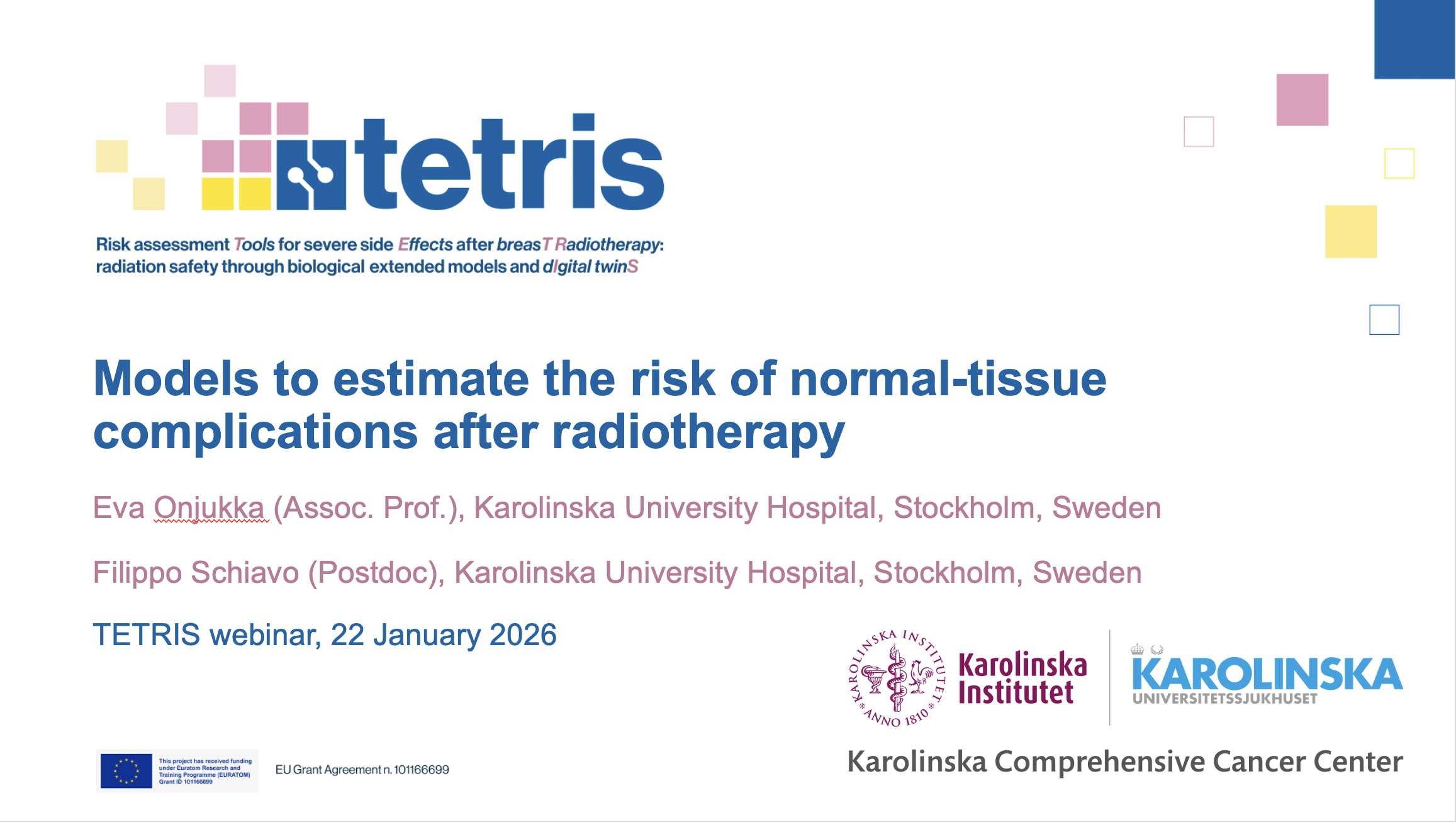
Her lecture on Models to estimate the risk of normal-tissue complications after radiotherapy focused on radiation-induced side effects in patients treated with radiotherapy and on how these outcomes are measured using clinician- and patient-reported scales. She explained why logistic regression often is a natural choice in Normal Tissue Complication Probability (NTCP) models, when predicting severe late side effects. Particular attention was given to the translation of complex 3D dose distributions into meaningful dose-volume metrics, such as DVHs and equivalent uniform dose (EUD), and to how these models support personalised follow-up strategies in WP2.
Please find Eva Onjukka’s presentation here: Models to estimate the risk of normal-tissue complications after radiotherapy.
During the second part, Filippo Schiavo delivered a presentation focused on NTCP model selection strategies.
He discussed how risk scores in TETRIS derive from models selected from the literature, and how these models are systematically reviewed, compared, and tested within the TETRIS cohort. His talk highlighted the importance of evaluating model performance, with a strong emphasis on calibration, crucial for communicating absolute risk to patients, alongside discrimination metrics. He also outlined the methodological framework adopted in TETRIS to ensure robust, transparent, and clinically meaningful model selection.
Please find Filippo Schiavo’s presentation here: Models to estimate the risk of normal-tissue complications after radiotherapy.
The webinar “Dose-response modelling for normal tissues and model selection strategy” has been recorded and is available on TETRIS YouTube channel here.
This first event officially opens the TETRIS Educational Series, which aims to provide high-quality training opportunities, stimulate dialogue among experts, and engage a wider audience interested in radiation safety and innovation in cancer care.
The next webinar, titled “Methods for Assessing Imaging Biomarkers in Breast Cancer Radiotherapy within the TETRIS Project”, will take place on 26 February and will be delivered by Claudio Fiorino and Martina Mori from Vita-Salute San Raffaele University (UniSR).